What is ShadowVPN?
ShadowVPN is a UDP-based, pre-shared-key (PSK), user-mode VPN written in Rust on the tokio async runtime.
It is a fixed point-to-point / multi-client tunnel. A TUN-based client reads IP packets from a virtual interface, encrypts each as a single UDP datagram, and sends it to the server; the server decrypts, routes, and tunnels return traffic back. It runs on macOS (utun) and Linux, and the client also runs on Windows (TUN via Wintun), including policy routing.
The on-wire crypto matches the shadowsocks.org AEAD UDP scheme exactly, so the construction is spec-correct and interoperable, with one deliberate, documented deviation (no SOCKS address header — see the wire protocol reference).
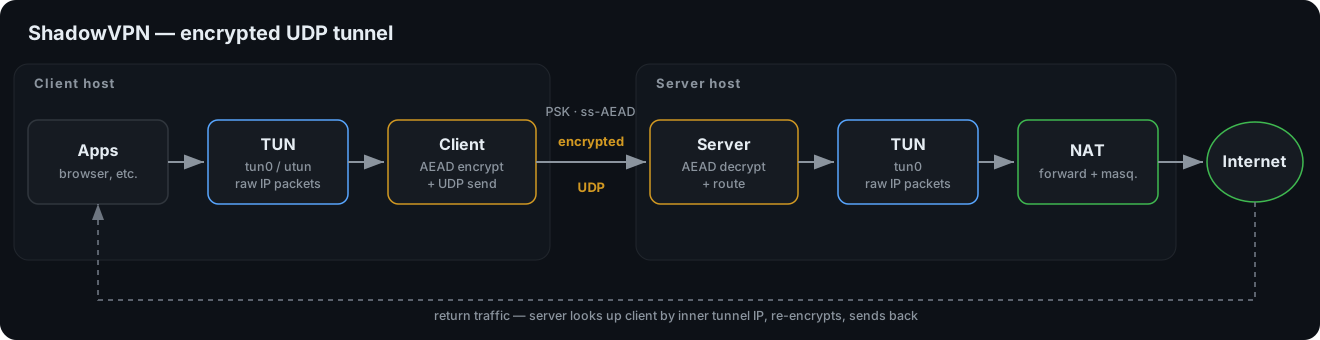
How it works
The client encrypts every TUN packet to the server over UDP; the server decrypts, writes to its own TUN, and (with forwarding + NAT) lets traffic egress. Return traffic is matched back to the client by its inner tunnel IP and re-encrypted.
Key properties:
- One packet, one datagram — the plaintext is the raw IP packet read from the TUN device. UDP datagram boundaries are the frame boundaries: there is no length prefix, no multiplexing, and no reassembly.
- Entirely in user space — ShadowVPN brings the TUN interface up and (in policy-routing mode) programs per-destination routes through the OS's native routing socket. No kernel modules, no
ipset/iptables/nftrules. - 0-RTT — there is no handshake or session negotiation. A client just starts sending; the pre-shared key is all either side needs.
- Pipelined data plane — dedicated reader tasks overlap socket I/O with the per-packet crypto, carrying single-flow TCP at ~1 Gbit/s through the tunnel (see benchmarks).
What ShadowVPN is not
- Not a SOCKS proxy. Standard shadowsocks UDP relays prepend a SOCKS-style target address to the plaintext; ShadowVPN does not. It is a fixed tunnel — the plaintext is exactly the raw IP packet.
- Not a key-exchange protocol. There are no certificates, no PKI, and no per-session keys: both ends share one password, and every datagram derives a fresh subkey from a random salt.
- Not a kernel VPN. Everything — crypto, routing decisions, DNS policy — happens in a normal user-space process (which still needs root/Administrator to create the TUN device).
Platform support
| Platform | Server | Client | Policy routing |
|---|---|---|---|
| Linux | ✅ | ✅ | ✅ (rtnetlink) |
| macOS | ✅ | ✅ | ✅ (PF_ROUTE) |
| Windows | — | ✅ (Wintun) | ✅ (IP Helper API) |
Next steps
- Quick start — tunnel up in five minutes.
- Installation — build from source, releases, Windows setup.
- Configuration — JSON config and CLI flags.
- Wire protocol — the exact on-wire format.